The Collector's Eye: A Beginner's Guide to Vintage Watches
Why the smartest investment you make this year might tick
 Image
ImageThe appeal of a vintage watch is not rational. It keeps worse time than your phone. It requires regular servicing that costs more than most new watches. It is fragile, impractical, and will almost certainly need a new crystal within the first year of ownership. And yet, once you strap one to your wrist and feel the subtle vibration of a mechanical movement that has been ticking since before you were born, you understand why people build entire rooms to house them.
Vintage watch collecting has undergone a dramatic transformation in the past decade. What was once the province of retired gentlemen with magnifying loupes and leather-bound catalogues has become one of the most active alternative investment markets in the world. Prices for certain references have increased tenfold. Auction records are broken quarterly. And the community, once insular and gatekept, has opened its doors — somewhat reluctantly — to a new generation of enthusiasts.
Where to Begin
The first rule of collecting, according to dealer and historian Émile Marchand, is deceptively simple: buy what moves you.
“Forget investment potential,” Marchand counsels from behind the counter of his Geneva shop, a space so small that two customers constitute a crowd. “The market is unpredictable. If you buy something solely because you think it will appreciate, you will be anxious every day you own it. Buy something that makes you happy when you look at it, and you will never regret the purchase.”
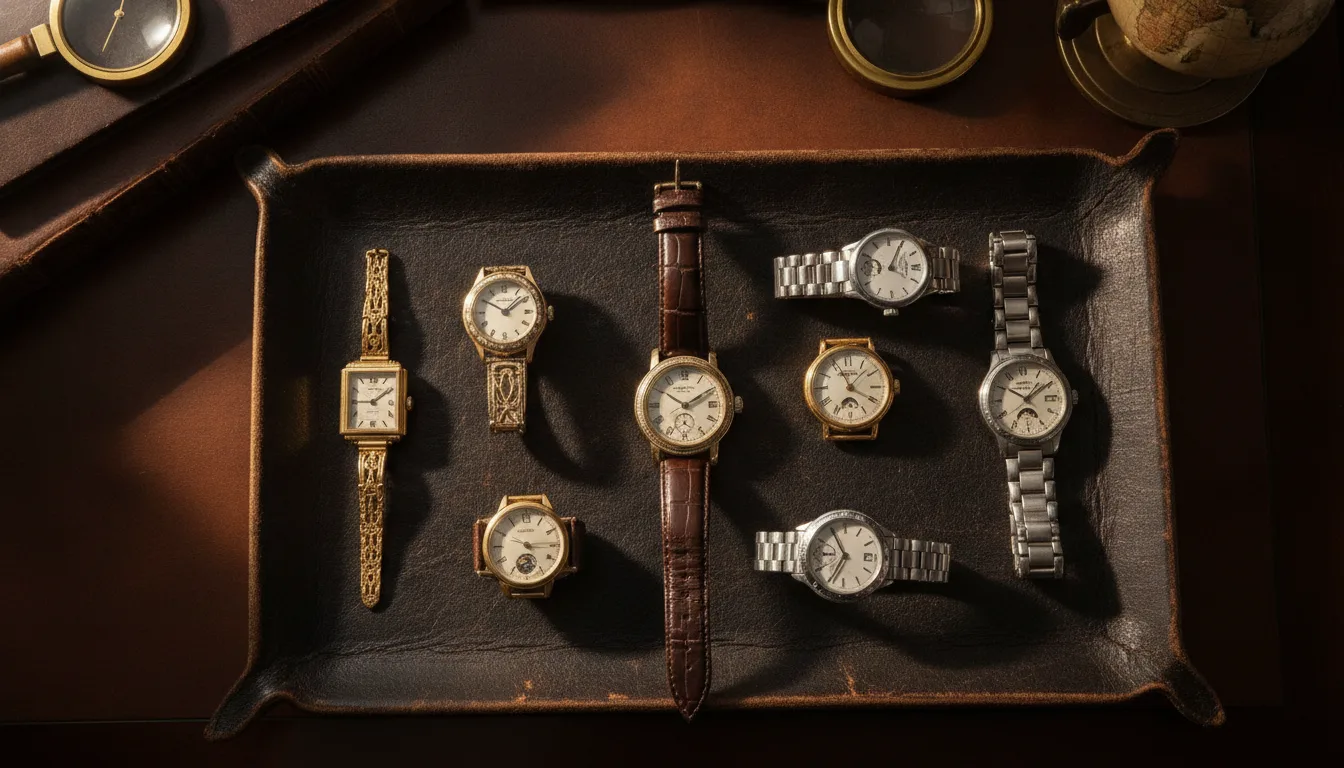
For beginners, Marchand recommends starting with hand-wound dress watches from the nineteen-fifties and sixties — a period he considers the golden age of accessible watchmaking. Pieces from this era can still be found at reasonable prices, their simple movements are inexpensive to service, and their restrained designs wear well with contemporary clothing.
The Anatomy of Value
What makes one vintage watch worth ten times another of similar age and apparent quality? The answer lies in a combination of factors that collectors refer to, only half-jokingly, as “the story.”
Provenance matters: a watch with documented ownership history commands a premium. Condition matters more: an original dial that has aged gracefully — what collectors call a “tropical” dial, where the colour has shifted over decades of sun exposure — can multiply value several times over. And originality matters most of all. Replacement parts, however well-intentioned, diminish value dramatically. The scratches, the patina, the slightly faded luminous markers — these are not flaws but evidence of a life lived on someone’s wrist.
The Pitfalls
The vintage market, like all markets driven by passion, attracts its share of opportunists. Counterfeit dials, mismatched cases, and so-called “Frankenwatches” assembled from parts of several donors are genuine risks, particularly at the lower end of the market where scrutiny is less rigorous.
Marchand’s advice is straightforward: buy from established dealers who offer guarantees of authenticity, attend auction previews to handle pieces in person, and never purchase anything significant from a photograph alone.
“A photograph tells you what a watch looks like,” he says. “But only your hands will tell you what it feels like. And feeling is everything in this business.”
The Long View
Collecting, at its best, is a form of stewardship. The watch on your wrist was made by someone who is almost certainly no longer alive, was worn by someone whose story you may never know, and will — if you care for it properly — outlast you by generations.
There is something grounding about that. In an era of planned obsolescence and disposable consumption, a vintage watch is a small, ticking argument for permanence.
Horlogerie Marchand is open by appointment in Geneva. Annual watch fairs in Basel and Geneva offer opportunities to view and purchase vintage pieces from international dealers.
 Image
Image Image
Image